
One proxy. Full control over every model call.
Govern data exposure, route requests intelligently, and make every model call auditable.
Built for engineering teams shipping AI in production. Once you're past the prototype, you need policy enforcement, cost controls, and a complete audit record — not just a provider API key.
Not ready to build? Join our Slack to see what others are building and chat with the engineering team.
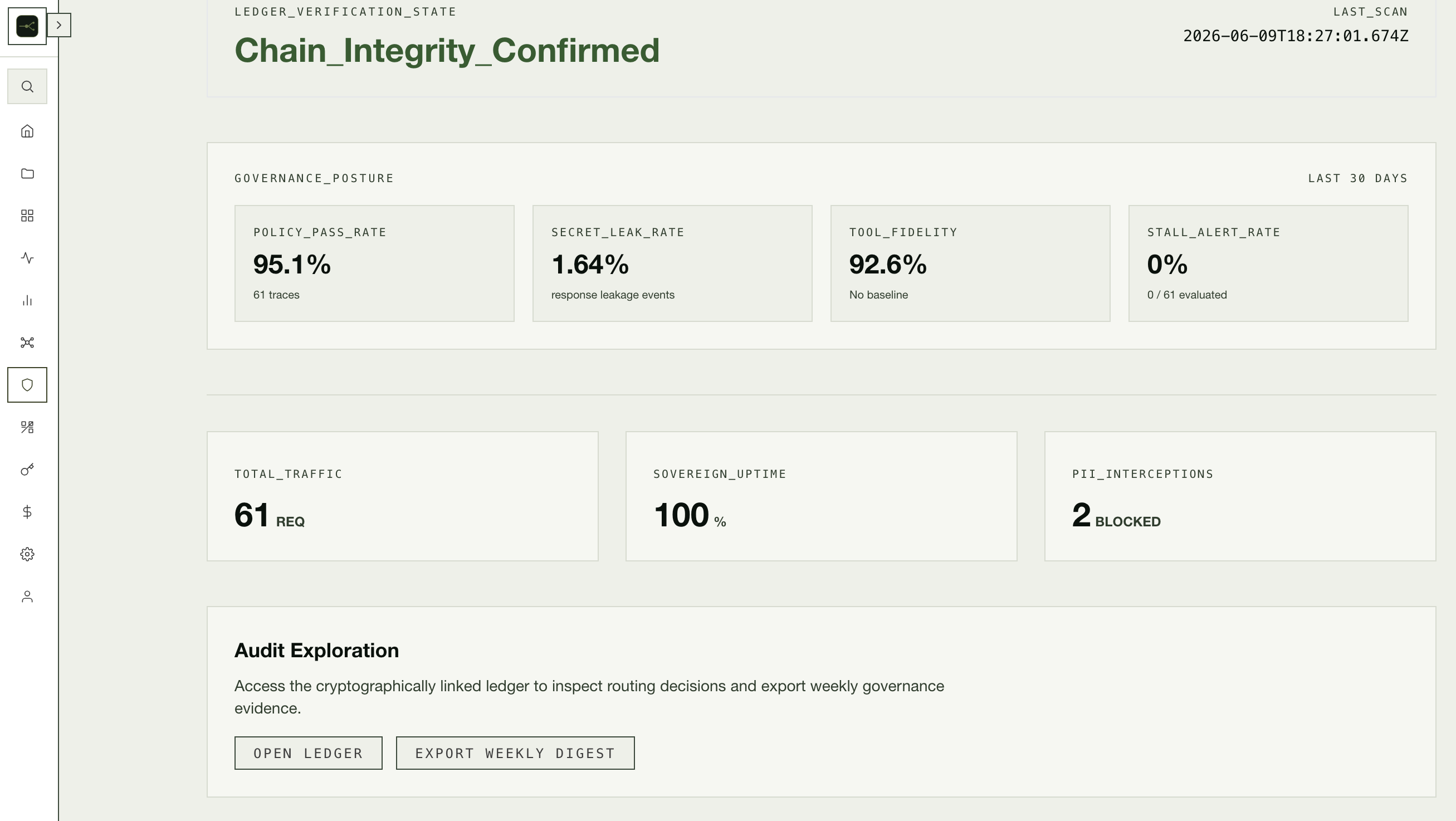
When compliance asks, the record is already there.
Every policy decision generates a signed ledger entry. Nothing to configure, nothing to enable separately — the record follows the trace from the first request.
A record of every decision, always. Every routing choice is logged in a tamper-proof ledger you can export and verify.
The same ledger supports report generation, export workflows, and evidence reviews without leaving the trace record.
Same rules. Different decisions.
Hey, can you look at this support ticket and give me a quick summary? The customer is Alex Johnson and his card number is 4242 4242 4242 1234.
$ olyx trace --local-ref ticket_24A1
id: trace_01J6AF...
status: pending
distribution.payload_storage_mode: cloud_anonymized
I've got 2,000 support logs from last quarter. Can you read through them and tell me the top three things customers keep complaining about?
$ olyx trace --local-ref batch_run_09
id: trace_01J7BB...
status: pending
distribution.payload_storage_mode: cloud_anonymized
Here's a patient intake form — can you extract the diagnosis codes and flag anything urgent? This can't leave our network.
$ olyx trace --local-ref intake_form_03
id: trace_01J8CC...
status: pending
distribution.payload_storage_mode: customer_managed
distribution.local_ref: intake_form_03
Every request is evaluated against your policy, scrubbed where needed, then routed on cost and intent complexity. Three inputs — three different outcomes from the same control plane.
Three steps to full control.
Use the CLI for the fastest path, or call the HTTP API directly — no binary required.
$ gh release download v0.1.0 --repo Olyx-labs/Olyx-CLI
$ olyx login
Opening https://app.olyxai.io/login
$ export OLYX_API_KEY=ak_...
$ olyx inspect
Point your existing AI client at the Olyx endpoint. No other code changes required.
client = ProviderAI(api_key="...")
base_url="https://olyx-edge.internal/v1"
Record the request with a local reference, then open the trace detail to inspect routing, security signals, boundary evidence, and replay status.
$ olyx trace --local-ref ticket_24A1
    id: trace_01J6AF...
    status: pending
    distribution.local_ref: ticket_24A1

$ olyx complete trace_01J6AF...
    status: completed
    optimization_grade: B
    total_cost: 0.0184
    summary.latency_p95: 842
    trace_detail: routing, security, boundary
One integration. Complete execution control.
Keep your existing AI clients and add Olyx to the request path. Provider credentials never leave your environment.
OpenAI-schema compatible — base URL change only. Providers with a different native API shape (Anthropic, Gemini, Bedrock) use built-in schema adapters.
Rules applied before every model call — not after.
Route by cost, latency, or sensitivity. Automatic failover.
Every decision recorded with full input/output context.
Requests blocked or redacted when policy requires it.
You decide what gets through, what gets redacted, and where your data lands.
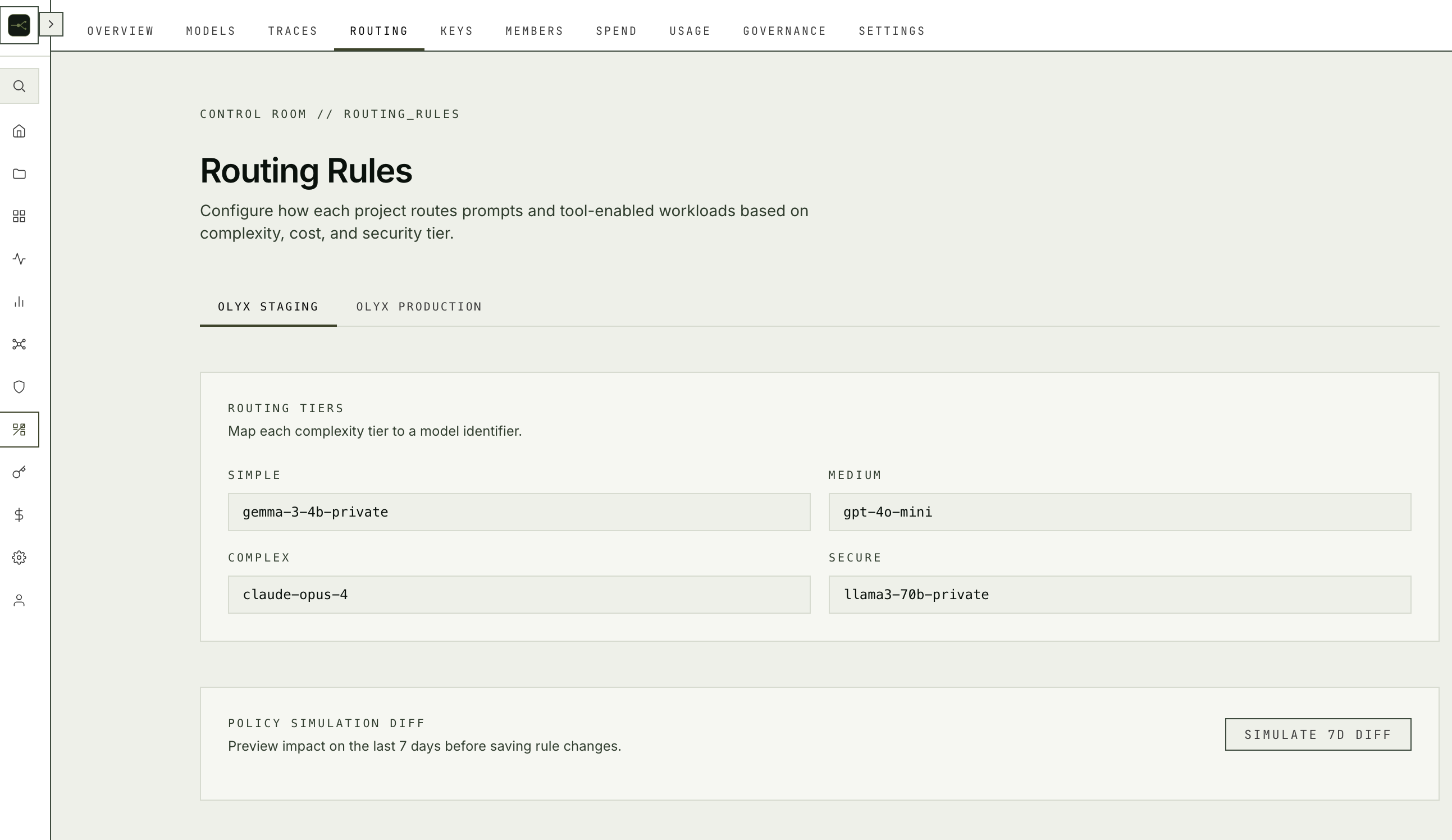
Configured rules can redact sensitive values, alert your team, or block the request entirely. Sensitive fields stay out of cloud storage when your policy requires it.
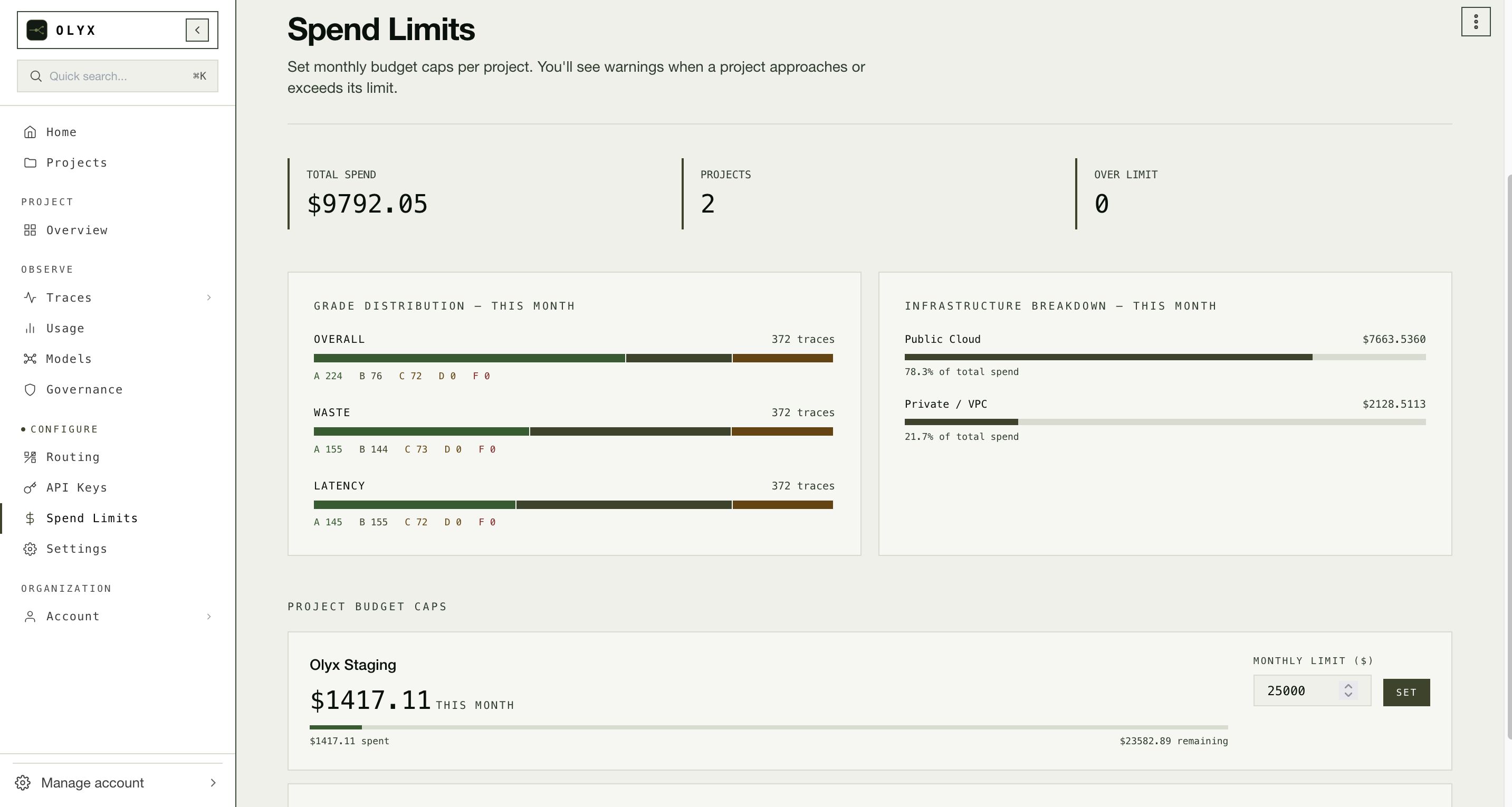
Compare traces and replays to see which route ran, what it cost, and where latency landed — instead of piecing it together from provider logs.
Your API keys and data stay in your environment by default. Cloud-side coordination is optional and policy-driven — not assumed.
One base URL. Zero secrets stored. Every decision traced.
Keep your existing AI client code and point it at the Olyx endpoint.
Your AI provider API keys stay in your environment — never sent to Olyx.
Every request is logged with its routing decision, cost, and policy outcome.
Production AI needs a control plane.
Every request governed. Every route intentional. Every decision observable.